
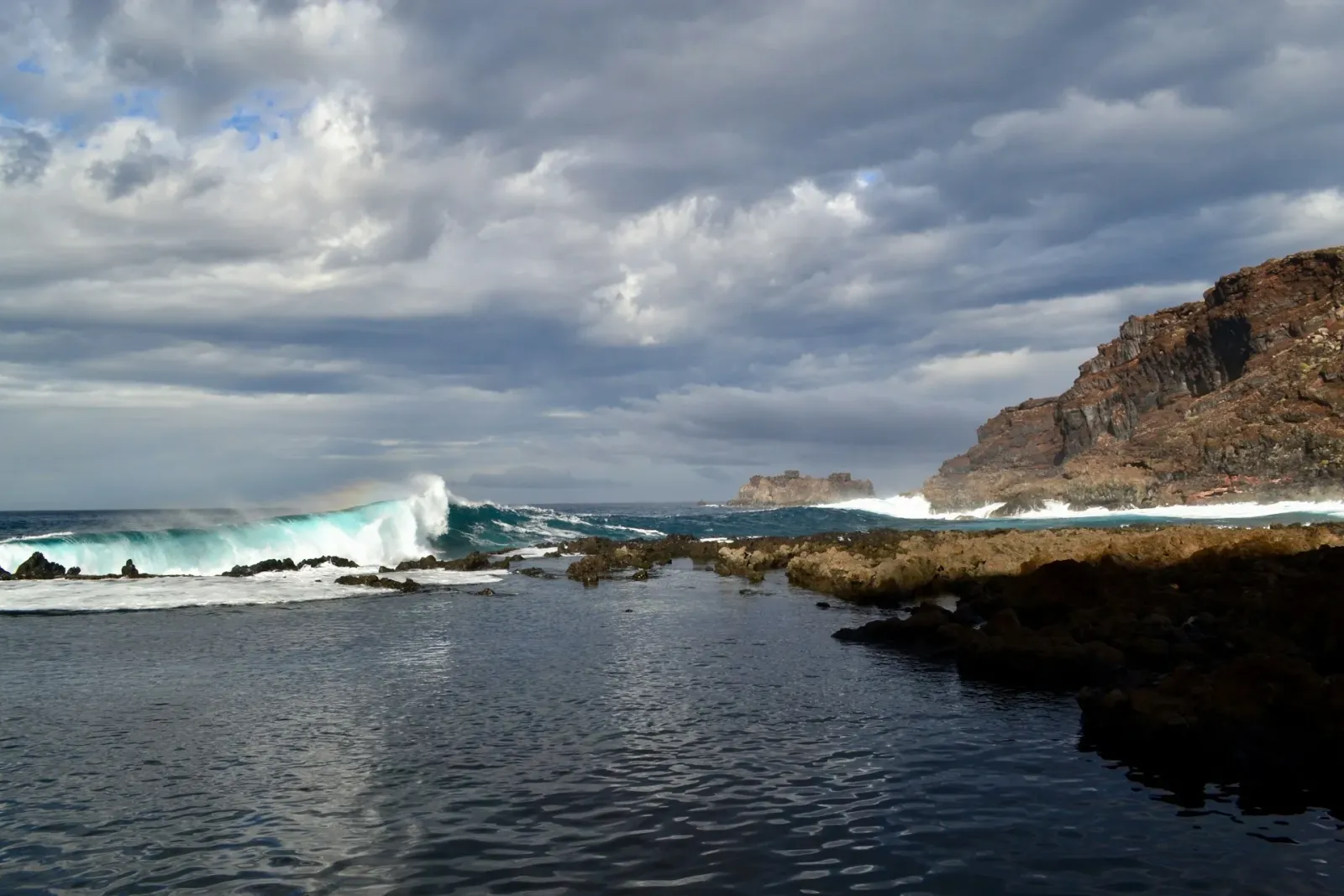
El Hierro DO
- Latitude
- 27°44′24″ N
- Longitude
- 18°01′48″ W
- Appellations
- 0
Imagine standing at the very edge of Spain, where volcanic slopes spill into the Atlantic and vineyards cling to steep cliffs like brave climbers. That's El Hierro DO, the smallest and most enchanting wine region in the Canary Islands, a hidden treasure of courageous viticulture. Here, ancient pre-phylloxera vines flourish in volcanic ash soils, crafting wines that beautifully reflect a harmonious blend of earth and ocean.
This guide is perfect for wine lovers, sommeliers, and travelers eager to discover a remarkable, terroir-driven region. El Hierro offers an authentic taste of volcanic winemaking, with family-run wineries producing small, carefully crafted batches and a winemaking heritage dating back to 1526. If you're after mass-produced wines, this might not be your spot. But if you’re yearning for authenticity, rustic charm, and stories in each bottle, we invite you to explore this incredible place.
Overview of the Region
El Hierro, the smallest and westernmost island in the Canary archipelago, covers just 268.51 km² (103.67 sq mi). Despite its modest size, this volcanic gem offers a stunning variety of landscapes, featuring steep slopes, dramatic cliffs, and the impressive extinct volcano El Golfo as a striking centerpiece. Within this compact area, El Hierro experiences a range of climates and microclimates that help grape varieties like Listán Negro and Listán Blanco thrive in different conditions.
The main wine-producing areas, or subregions, within the El Hierro DOP are Valle del Golfo, Echedo, and El Pinar. These recognized subzones beautifully define the island’s viticultural scenery. Each one has its own distinct microclimate and terroir, adding to the rich diversity and character of El Hierro wines.
The island’s key wine zones—Valle del Golfo, Echedo, and El Pinar—feature charming terraced vineyards built from stones, situated on slopes that range from near sea level up to higher elevations. These varying altitudes create unique microclimates that bring depth and complexity to the wines.
Although grape growing on El Hierro dates back to the 16th century, it wasn’t until 1995 that the region received its official Denominación de Origen (DO) status, marking a proud milestone in its winemaking history. What makes El Hierro truly special is that it remains a vibrant vineyard museum: a place untouched by the phylloxera plague, with many vines still growing on their original rootstocks, a rare find in today’s wine world.
The island’s vineyards flourish in naturally infertile soils, including clay, lime-rich marl, sand, and volcanic ash. El Hierro stands out among the Canary Islands because of its reliance on old, ungrafted vines. Instead of large-scale farms, the island is a patchwork of approximately 250 small-scale growers, each tending less than one hectare on average, helping preserve ancient traditions and grape varieties that have been lost elsewhere.
El Hierro, by the Numbers
El Hierro is a charming, small-scale wine region with a strong sense of character. Its limited size, with only 126–203 hectares of vineyards, and its roughly 13 registered wineries along with about 240 small growers, give it a warm, artisanal feel. Despite being located farther south, the cool Atlantic breezes, combined with 3,000 hours of sunshine and elevations up to 700 meters, create ideal conditions for wines that are fresh, well-balanced, and long-lasting. These distinctive traits highlight El Hierro’s identity as a terroir-driven volcanic region rather than a large-volume producer.
- Total Vineyard Area
- 126–203 hectares (311–501 acres)
- Registered Wineries
- 13
- Registered Viticulturists
- 238–250
- Altitude Range
- 125–700 meters / 410–2,297 feet above sea level
- Annual Sunshine Hours
- 3,000 hours
- Annual Precipitation
- 150–400 mm (5.9–15.7 inches), varying between the east and west coasts
- Average Temperatures
- 17–23°C (62.6–73.4°F), depending on season
- Maximum Summer Temperature
- Rarely exceeds 28°C (82°F)
- DO Status Granted
- 1995
- Growing Degree Days
- Subtropical at lower altitudes; continental-like above 700 meters
History of the Subregion
El Hierro's viticulture story is a fascinating journey through history, with each era leaving its mark on the island's unique wine heritage.
- In the 16th and 17th centuries, the island's wine adventure took off in 1526 when the Englishman John Hill first planted vineyards. Known as “the mountain of the vine” by sugar merchant Thomas Nichols, El Hierro quickly became famous for its sweet fortified wines and Canary Sack, highly valued exports to Venezuela, Cuba, and England. This period created a deep cultural bond, famously alluded to by Shakespeare in his plays with “a cup of Canary.”
- Moving into the 18th and 19th centuries, the island faced challenges as British trade shifted to Portuguese wines after the 1663 Staple Act, which reduced demand for El Hierro’s wines. Yet, this period also highlighted the island’s fortunate isolation. When the phylloxera plague swept through European vineyards in the late 19th century, El Hierro remained untouched, preserving its rare pre-phylloxera vines and grape varieties now extinct elsewhere. This made the island a vital living genetic reservoir.
- From the 20th century to today, the island has enjoyed a remarkable revival. Starting in the 1980s, with the creation of Central Vinícola Insular to support local growers, the first harvest in 1986 yielded 230,000 liters, sparking higher quality and renewed enthusiasm. These efforts led to provisional Denominación de Origen (DO) status in 1990 and full Denominación de Origen Protegida (DOP) recognition in 1995. Today, under the careful oversight of the Consejo Regulador, strict standards are maintained, transforming El Hierro from a historical footnote into a well-respected, modern wine region.
Environment and Sustainability Practices
Back in 2014, El Hierro made history as the first island in the world to become energy self-sufficient, running entirely on a mix of hydro and wind renewable energy systems. This pioneering spirit extends to its vineyards too! About 80% of the vineyards are on steep slopes in tiny, less-than-a-hectare plots, making mechanization impossible. That’s why organic practices are so vital here.
Several wineries, like Bimbache, are proud to pursue organic certification. The island actively protects its genetic diversity by serving as a refuge for phylloxera-resistant vines, preserving heirloom varieties such as Vijariego, Baboso, and Negramoll that have vanished elsewhere. Water management here relies on the volcanic soil's natural moisture retention, along with dry-farming techniques suited to the limited rainfall. The century-old terraced vineyards not only look stunning but also help prevent soil erosion.
Producing just a few hundred to a few thousand bottles per year, these small-scale wineries help reduce packaging waste and shorten supply routes. This genuine, sustainable approach to viticulture focuses on maintaining biodiversity and celebrating local identity, rather than pursuing industrial-scale monoculture.
- Vineyard hectares
- 203
- Wineries
- 13
- growing degree days
- 1500–1900 GDD
Discover Terroir
El Hierro lies at approximately 27°48’N, 17°54’W, making it the southwesternmost point of Spain and historically regarded as the edge of the known world. Its remote location—several hours by ferry from Tenerife—has helped preserve its unique ecology and vibrant wine culture.
This Designation of Origin (DO) enjoys a gentle, temperate climate influenced by trade winds, with the Canary Current bringing mild summers. Bright sunshine is common, with 3,000 hours annually, and temperatures rarely exceed 28°C. Rainfall varies, with about 400 mm in the west and 150 mm in the east. Overall, the climate is mild and dry near sea level, becoming more humid at higher altitudes.
The volcanic soils of El Hierro are a blend of clay, marl, sand, and ash—nutrient-poor yet water-retentive soils that lend a notable minerality to the vineyards, particularly in Valle del Golfo’s dramatically exposed, mineral-rich sites. The rare Baboso Blanco grape, mainly cultivated between 300 and 700 meters above sea level, thrives in these distinctive conditions. Like El Hierro, La Palma is celebrated for its unique volcanic soils and diverse microclimates, which give its grape varieties a distinct character and showcase the variety of terroirs across the Canary Islands.
- Rain
 150–400 mm
- Altitude
 125–700 m
Discover
The Signature Grape Varieties of El Hierro
El Hierro boasts 14 authorized grape varieties that beautifully combine indigenous Canarian grapes with historic European imports. For white wines, you'll find standout varieties like Vijariego Blanco, Listán Blanco, Bermejuela, and Gual, while red wines include characterful grapes such as Listán Negro, Negramoll, Vijariego Negro, Baboso Negro, and Tintilla. Notably, Vijariego Blanco’s exceptional acidity truly highlights the region’s distinct identity and its excellent aging potential.
- Vijariego Blanco
- Color: White
- Origin/Notes: Indigenous Canarian variety; dominant white grape; produces wines with tropical fruit notes, minerality, and high acidity
- Listán Blanco
- Color: White
- Origin/Notes: Widespread across the Canary Islands; versatile variety used in both dry and sweet wines
- Bermejuela
- Color: White
- Origin/Notes: Indigenous white variety
- Gual
- Color: White
- Origin/Notes: Traditional Canarian variety used in quality white wines
- Malvasía Aromática
- Color: White
- Origin/Notes: Aromatic Malvasia strain; used for both dry and sweet wines
- Malvasía Volcánica
- Color: White
- Origin/Notes: Volcanic Malvasia variant unique to the Canary Islands
- Bremajuelo (Marmajuelo)
- Color: White
- Origin/Notes: Highly regarded indigenous variety; survived phylloxera only in the Canaries
- Baboso Blanco
- Color: White
- Origin/Notes: Minority white grape cultivated mainly on El Hierro at 300–700 m altitude; short cycle, disease-sensitive; produces fruity wines with apricot and tropical notes
- Verdello
- Color: White
- Origin/Notes: Traditional white variety
- Listán Negro
- Color: Red
- Origin/Notes: Most cultivated red variety in the Canary Islands; a natural cross between Mollar Cano and Palomino Fino that originated in the Canaries; well-adapted to volcanic soils
- Negramoll (Mulata)
- Color: Red
- Origin/Notes: Second most planted red variety; originated in Andalucía; medium-low production, long cycle
- Vijariego Negro
- Color: Red
- Origin/Notes: Indigenous red variety; often compared to Sumoll due to structural similarities and adaptability, with a historical connection to Catalonia
- Baboso Negro (Alfrocheiro)
- Color: Red
- Origin/Notes: Arrived from Alentejo, Portugal; short, compact clusters with sensitive skins prone to splitting; cultivated primarily on El Hierro and Tenerife
- Tintilla (Trousseau Noir)
- Color: Red
- Origin/Notes: Red variety used in quality wines
Wine Styles of El Hierro DO
Even though the region is small, it offers a delightful array of wines, mostly white (about 70%), with reds and sweet wines becoming increasingly popular. Enjoying El Hierro wines is a wonderful way to connect with local traditions, making your visit even more meaningful. The average price is around 7 euros, while special bottles can be found for about 15 euros, giving great value for quality. Pairing these wines with regional dishes allows visitors to truly savor the island's unique flavors. Tasting local wine alongside traditional foods enriches your culinary journey and showcases El Hierro’s vibrant culture.
- Vino Blanco (White)
- Characteristics: Clean, bright, pale yellow to golden; medium-intensity aromas with tropical fruits, citrus, and pronounced minerality; high acidity, fresh, balanced; some barrel-aged versions with integrated oak
- Minimum Alcohol: 11% vol.
- Vino Blanco Espumoso (Sparkling White)
- Characteristics: Bright, pale yellow to golden; small, persistent bubbles; aromatic profile similar to still whites
- Minimum Alcohol: 11% vol.
- Vino Rosado (Rosé)
- Characteristics: Clean and bright, pale to intense pink; medium intensity with fruity notes; slightly acidic, balanced, fruity palate
- Minimum Alcohol: 11.5% vol.
- Vino Tinto (Red)
- Characteristics: Clean and bright, reddish from violet to garnet; frank, fruity with primary aromas; balanced tannins with alcohol–acidity equilibrium; persistent; traditionally rustic and intense
- Minimum Alcohol: 12% vol.
- Vino Tinto Maceración Carbónica (Carbonic Maceration Red)
- Characteristics: Medium-high intensity, cherry red with violet tones; intense aromas recalling ripe fruit, banana, fresh berries, and violet; fresh, aromatic, youthful character
- Minimum Alcohol: 12% vol.
- Vino Tinto Crianza / Reserva / Gran Reserva (Aged Reds)
- Characteristics: Red garnet to ruby with brick tones; medium-high intensity; oak aromas (vanilla, toast, spices, balsamic); ripe fruit notes for Crianza, preserved fruit for Gran Reserva; persistent finish
- Minimum Alcohol: 12% vol.
- Vino de Licor (Fortified)
- Characteristics: Amber colour (white base) or reddish tones (red base); intense aromas of dried fruits and/or spices; balanced, intense, velvety; powerful and persistent fruity finish
- Minimum Alcohol: 15% vol.
- Vino Dulce Clásico (Classic Sweet Wine)
- Characteristics: Amber and unctuous appearance (white) or reddish with varying intensity (red); intense aromas of dried fruits and spices; balanced, intense, velvety; powerful fruity finish; high sugar balanced by acidity
- Minimum Alcohol: 14% vol.
White Wines (Vijariego Blanco, Listán Blanco-based)
High acidity and mineral notes complement Atlantic seafood beautifully. Grilled prawns, octopus, and tuna tartare enhance the volcanic salinity characteristic of these wines. They also go well with local cheeses, tangy salads, and papas arrugadas with mojo verde—the wines' brightness balances richness effectively. The local goat cheese from San Andres pairs perfectly with white wines from El Hierro. Additionally, Pez Peto, a local fish, pairs nicely with Bodega Frontera's Blanco Seco. Overall, wines from El Hierro are often enjoyed with local seafood and goat cheese for a memorable dining experience.
Rosé Wines
Lighter tapas, fried calamari, and seafood paella pair well with rosé's fruity notes and balanced acidity. These wines enhance mildly spiced dishes without overpowering them, making them some of summer's most adaptable partners.
Red Wines (Listán Negro, Baboso Negro-based)
Rustic tannins complement hearty proteins such as grilled meats, conejo en salmorejo, ropa vieja, and aged Manchego. The volcanic earthiness is evident in smoked dishes and charcuterie, where mineral notes contrast with salt-cured flavors. Red wines from Bodega Frontera also pair well with smoked goat cheese.
Carbonic Maceration Reds
Fresh, aromatic profiles complement charcuterie and mushroom dishes beautifully. Serve them slightly chilled with lightly grilled meats or enjoy as an aperitif. The wines' youthful vibrancy goes beyond traditional food pairings.
Sweet and Fortified Wines
El Hierro's secret weapons include pairings that perfectly balance flavors. Blue cheese uses acidity to offset its richness, while foie gras and almond-honey desserts highlight their complex profiles. The local quesadilla herreña pairs well with wines with balanced acidity, ensuring the sweetness doesn’t become overwhelming despite the high residual sugar.
Wine Tourism in El Hierro
Visiting El Hierro seamlessly blends its rich wine heritage with a contemporary flair. As a UNESCO Biosphere Reserve powered solely by renewable energy, the island offers authentic enotourism experiences away from the crowds.
Cozy, small wineries host visitors by appointment, offering intimate tastings and vineyard tours that highlight the effort behind each vineyard. The hand-built volcanic stone terraces cannot be mechanized, so all work is done by hand, adding to the island's charm. Visitors can enjoy guided tastings, walk through the striking Valle del Golfo vineyards with Atlantic views, and savor pairings with fresh seafood and artisanal cheeses.
El Hierro's small size makes it easy to visit multiple wineries in a single day while also exploring natural sights like Mirador de la Peña’s stunning vineyard vistas and Punta Grande, the world’s smallest hotel certified by Guinness. The wine routes cleverly combine visits to Valverde and La Candelaria church in La Frontera, with breathtaking viewpoints overlooking lush vineyards and banana plantations.
Best Wineries within the El Hierro DO
Here are some of the most notable wineries in the El Hierro DO, each enriching the region's distinctive wine culture by blending tradition with innovation. It's fascinating to see how these wineries bring their unique touch to the local wine scene!
- Bimbache Vinícola: Founded in 2018 by Rayco Fernández and Silvia Viot, this exciting new winery moved from Lanzarote's Puro Rofe to embrace El Hierro's unique indigenous varieties. They cultivate organic grapes on both owned and rented plots, producing wines of exceptional quality—usually fewer than 2,000 bottles per batch. The Wine Advocate has recognized their efforts, praising the true expression of purity and terroir in every bottle.
- Bodega Tanajara: Nestled at 650 meters in Pinar, this charming producer embodies a dedication to quality winemaking. John Hill, a proud descendant of a 16th-century vine planter, lovingly cultivates Vijariego Negro and Baboso Negros on steep volcanic slopes. His unfiltered reds, aged in oak, have earned well-deserved recognition from DOP Islas Canarias for their outstanding Baboso Negro monovarietal.
- Bodega HM Las Vetas: Herminio Sánchez's Sabinosa bodega is known for its delightful sweet wines, a true reflection of El Hierro's unique style. The vineyard, thriving on 72% slopes where you can enjoy "Europe's last sunset," is lovingly cultivated with Vijariego, Listán, and Gual grapes. Every step is handcrafted, from careful cultivation to traditional lagar treading. With such small production runs—sometimes only 400 bottles each year—and numerous awards, these wines are truly special collector's treasures.
- Bodega Elysar: Self-taught winemaker Ambrosio Martín Padrón lovingly founded this El Pinar bodega in 2012, carefully cultivating 20,000 m² with Negramoll, Listán Blanco, Vijariego, and Baboso grapes. You can enjoy three fantastic labels—Elysar Tinto, Tinto Baboso, and Blanco Seco—that beautifully showcase the unique high-altitude terroir. A Bacchus award truly highlights his passionate dedication to quality and leadership in winemaking.
- Cooperativa del Campo Frontera: The historic roots of modern El Hierro winemaking are special, with this cooperative evolving from the Central Vinícola Insular in the 1980s. Viña Frontera's award-winning carbonic maceration red (Gran Medalla de Oro, AgroCanarias 2021) beautifully showcases the collective effort of many dedicated small growers, making it an inviting way to experience El Hierro's rich wine culture. Bodega Frontera is a friendly cooperative winery known for producing high-quality wines that offer great value.
- Uwe Winery: Uwe Winery, managed by a knowledgeable German, warmly contributes to the region's charm by highlighting native grape varieties, adding a special touch to the area's reputation.
Are you interested in collaborating with us?
Get started